EN

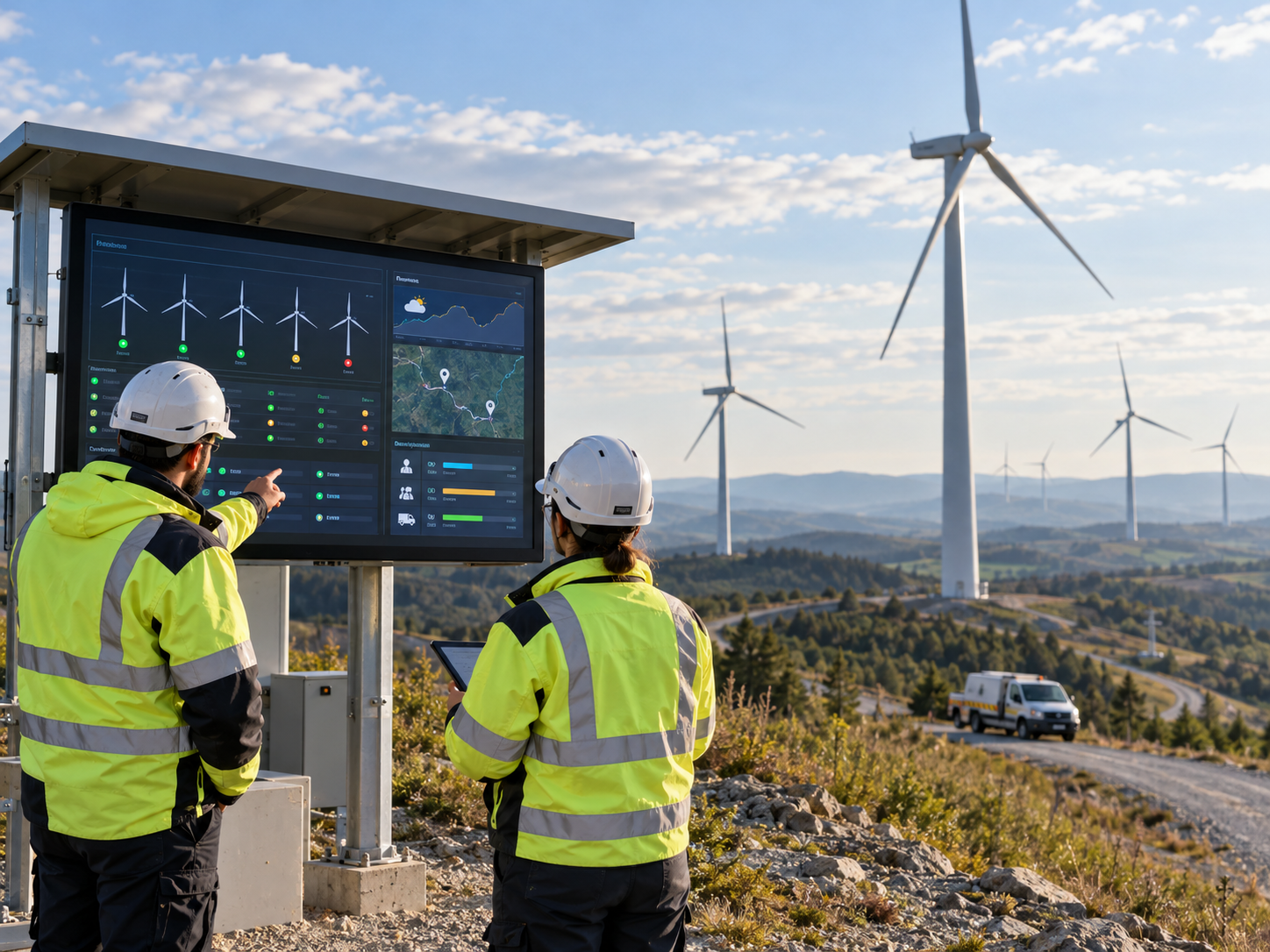
An outdoor LED display at a wind farm can give field crews a shared view of reported turbine conditions, current weather information and crew assignments before they leave the maintenance base. Its role is to make operational information easier to check at a briefing or departure point. Turbine data, weather assessments and work approvals must continue to come from the site's established systems and responsible personnel.
For operations and maintenance (O&M) managers, the purchasing question is not how much information can fit on an LED board. It is whether crews can reliably distinguish an equipment condition from permission to proceed, especially when weather information or assignments change after the morning briefing.
Show the Crew Decision Behind Each Turbine Status
A turbine status is useful for dispatch only when crews can tell which turbine a task concerns and whether the work has been authorized to begin. A display can show a recorded dispatch decision beside an equipment status, but it must not make or approve that decision.
A label such as Stopped describes a reported operating condition. It does not establish isolation, access permission or completion of the site's required safety checks. A crew could be assigned to investigate that turbine while authorization for the actual maintenance activity remains pending. Putting these facts on separate lines makes their relationship clearer than displaying a single green status indicator.
For instance, a planning example might associate turbine T-17 with a reported stop, Crew B with the proposed task, and Dispatch approval pending with the current work decision. These are illustrative labels, not a customer installation or a recommended universal approval vocabulary. The site operator must define the language and the authoritative source of each field.
On wind farm maintenance status boards, the turbine identifier and work decision deserve the strongest visual emphasis. Reported status, crew assignment and update timestamp then explain the decision without competing with it. Colors may reinforce an operator-approved scheme, but plain language should remain understandable without color alone.
Use the same message test when reviewing an outdoor LED display board: ask the supplier to show how the proposed layout keeps the turbine ID, reported condition and dispatch decision distinct, and to explain how approved updates reach the screen.
Separate Weather Information From an Approved Work Window
A favorable forecast can identify a potential opportunity for maintenance planning. It cannot establish that conditions are safe for a particular task or that a crew has permission to proceed. Those judgments remain within the wind farm's approved work process.
Two common planning conditions explain why the distinction matters. In one, the approved weather source indicates a potentially suitable period, but the responsible supervisor has not issued approval. A message such as Forecast opportunity — approval pending communicates the planning position without implying clearance. In the other, work was previously assigned, but a revised forecast or other updated information requires reassessment. The board should reflect the resulting hold or review decision rather than continue to display an unqualified instruction to proceed.
The weather record needs its own context: source, forecast issuance time, applicable validity period and the time zone used. Forecast issuance and validity are not interchangeable. A forecast may have been published recently while referring to a later period, or a previously issued forecast may no longer be relevant to the proposed activity.
Likewise, an approved dispatch decision needs a separate approval state and confirmation time. Joining them into one apparently current timestamp can conceal which part has actually been reviewed. A wind farm display should keep these fields distinct, even when several turbine tasks are shown together.
The operator must define when a changed forecast triggers reapproval, delay or cancellation. The display should show the resulting review or hold status alongside the forecast's validity period, using wording approved for that site.
Locate Dispatch Information Where Field Teams Consult It
The right display location is the place where technicians actually confirm their assignment before traveling to turbines. That may be a maintenance staging point, a crew briefing area or a vehicle departure location. A prominent wall is not automatically the most useful position if crews do not stop there to read it.
At a departure point, the immediate questions are typically which turbine, which crew and whether dispatch has been confirmed. During a briefing, the same audience may have time to examine the underlying maintenance reference or why a planned weather window remains under review. Those reading moments call for different information priorities, even if the operator eventually selects the same display family.
Site engineers should observe where crews stand, how they approach the screen, how many assignments may appear simultaneously and whether the proposed location introduces obstruction or operational disruption. Real viewing positions matter more than assumptions based on a product photo. A message that looks orderly at close range may lose the association between turbine ID and approval state when read from a normal departure position.
The intended content route also belongs in the site brief. A manually maintained message, an operator-reviewed publication process and a connection to an existing information system imply different responsibilities. None should be treated as a confirmed feature of a particular product until supported by its supplier documentation.
Compare field dispatch display options using actual viewing conditions, available power, mounting constraints, exposure and safe access for maintenance. Those practical limits determine what can be proposed far more reliably than selecting a screen from a photograph alone. For a display installed in a coastal location, also review corrosion exposure, drainage and cable-entry details; the coastal outdoor LED project guide covers those additional considerations.
Define Update Ownership and Unavailable-Data Messages
A clear message can still mislead a crew when it remains on screen after its source has changed. Responsibility for each update should be decided before display design is finalized: who provides turbine status, who reviews the weather record, who authorizes the dispatch decision and who publishes the approved wording.
Those duties may be distributed among a maintenance coordinator, an authorized supervisor and a nominated display operator. The correct arrangement is the one that follows the site's established workflow. The screen should not introduce an informal second approval route.
An update timestamp should describe the information's confirmation or publication status, not simply repeat the display clock. When a crew assignment changes, the superseded message should be withdrawn or clearly marked according to the site's approved process. The operator also needs to decide how teams receive instructions if the screen is unavailable.
When the information is missing, say what is missing
A missing turbine status, an unconfirmed weather update and a pending dispatch approval are three different conditions. Reusing the last visible value without qualification can make the board appear more authoritative than its information deserves.
Useful operator-defined wording might include “Status unavailable,” “Forecast review required,” or “Dispatch approval pending.” The specific terms, escalation route and fallback communications must be agreed by the wind farm operator.
A supplier review should ask how content is entered, checked, revised and removed, and what happens when an update cannot be delivered. Any connectivity, automation or synchronization option needs project-specific evidence. The LED board remains an information channel; the authoritative instructions must be available through the site's established systems.
Match the Outdoor LED Display to the Site Brief
An outdoor LED display may be considered for a fixed crew briefing or departure point where teams need to check the same approved information. The category alone does not establish suitability: the selected model must be reviewed against actual viewing distance, ambient light, environmental exposure, mounting conditions, power supply, maintenance access and content-update requirements.
For procurement, a useful brief is more than a desired screen size. It should show where a decision is read, the exact information required and the boundaries between display communication and operational approval.
Information to include in the buyer brief
The selected supplier should then explain what evidence supports the proposed installation and content-update approach. Product specifications and drawings may help assess the hardware; an example message layout helps assess whether the crew can distinguish an approved task from a pending one. Neither is a substitute for the operator's documented procedures.

View Outdoor LED Advertising Screen
Frequently Asked Questions
Can a display decide whether weather conditions are safe for work?
Can one display serve both a crew briefing area and a vehicle departure point?
Next Project Step
Discuss Your Wind-Farm Dispatch Display Brief
Bring the dispatch point, turbine IDs, approved weather source, work approval workflow, update owner and actual installation conditions. Include a representative message showing the difference between a reported equipment state and an approved crew assignment.
With those details, the supplier can assess the display format, identify any unresolved hardware or content-update requirements, and prepare a project-specific proposal.