EN
EN

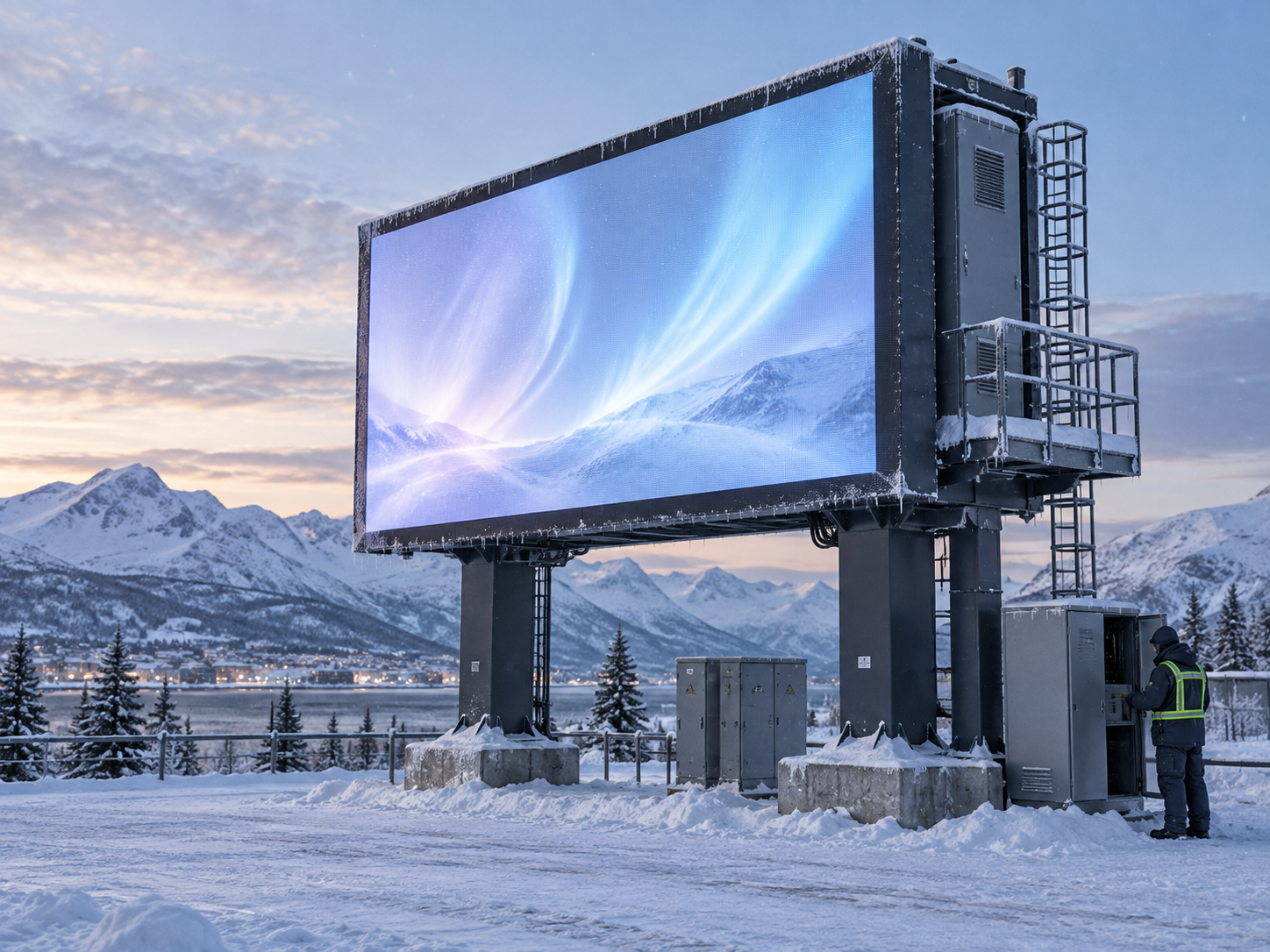
A cold-climate outdoor display project can look straightforward until the screen has been switched off through a freezing night and is expected to return to service the next morning. For a cold-weather outdoor LED display, the important question is not simply whether the installation is outdoors. The project needs a clear picture of what condition the display may be in before power is applied, how winter weather changes access around it, and whether start-up or enclosure arrangements need additional review.
Two installations in the same region can face very different operating situations. One may remain energised for long periods, while another shuts down every night. One may sit against a building with protected access; another may be freestanding beside a road, plaza or car park where snow is cleared around the structure. A location name alone does not describe those differences.
That is why the first conversation with an outdoor LED display supplier should include the site's temperature range, operating schedule, installation position, orientation, snow and ice exposure and maintenance conditions. The goal is not to assume that every cold location needs the same solution. It is to identify the conditions that could change configuration, start-up planning or service access before the installation details are fixed.
Quick Navigation
Define the Winter Operating Scenario Before Discussing the Screen
“Cold climate” is too broad to function as a useful project requirement by itself. A better brief separates the lowest expected site temperature from the conditions in which the screen normally operates. It also explains when the display is powered, how long it may remain off and what the operator expects when it is switched on again.
Consider a screen that runs during trading hours but is shut down overnight. Its most demanding operating moment may be the first start of the morning after the enclosure has spent hours in the surrounding cold. A second installation may normally run continuously, yet occasionally remain unpowered during a longer site outage. These are different planning situations even if the weather outside is similar.
Exposure also depends on installation geometry. A façade-mounted screen may have relatively protected access from the building side. A freestanding LED Advertising Board may have rear doors, a structural base and service space close to areas where snow is cleared or allowed to accumulate. Those physical differences belong in the project brief.
A more useful starting question
What condition will the display actually be in when somebody expects it to start, and what will the site around it look like at that moment?
Site photos should show more than the mounting point
Close photographs of the intended screen position are useful, but they can hide the conditions that later determine winter serviceability. Wider views should show the ground around the structure, the sides and rear of the installation, nearby walls or barriers and the route a technician would use to reach the display.
For a freestanding installation, this wider site context is particularly useful because the screen, supporting structure and surrounding service area operate as one physical space. A screen can remain easy to see while becoming difficult to approach from behind.

Low-Temperature Start-Up Is Different From Normal Operation
A display that has already been running is in a different operating state from equipment that has remained unpowered in a cold environment for an extended period. That distinction is easy to miss when a procurement document contains only an outdoor application description and a minimum site temperature.
The correct response is not for the project team to invent a start-up temperature, warm-up period or heating sequence. Those would be configuration-specific assumptions. Instead, procurement should describe the real operating sequence and ask the supplier to confirm how the proposed system should be handled in that situation.
Scenario A
Scheduled morning restart
If the display is deliberately shut down every night, state how long it is likely to remain unpowered and when normal service is expected to resume. For an advertising or information screen, the expected morning availability can be an operational requirement rather than a minor technical detail.
Scenario B
Restart after a prolonged outage
A screen that normally remains on may still experience a cold restart after a sufficiently long power interruption. The project team should clarify whether restoration is expected to happen automatically, after operator approval or through coordination with another control system.
This distinction becomes more important where several parties are involved. The electrical contractor may restore site power, the control system may issue a start command, and an operator may simply expect the screen to return. If nobody has defined the intended sequence, each party can make a reasonable but different assumption.
A better project brief states the expected low condition, typical shutdown duration, required operating schedule and intended restart behaviour. The supplier can then review whether the proposed arrangement needs any additional coordination before those expectations become part of site operations.
Temperature alone does not describe a cold start
The useful engineering question combines temperature, time without power and the required restart behaviour. Those three inputs describe the operating problem far more clearly than a single climate label.
Ask the supplier to confirm the proposed configuration, not only a minimum temperature
For the actual product and cabinet configuration being quoted, request written confirmation of the applicable operating temperature range, storage temperature range and the conditions under which a cold start is supported. Where relevant, the supplier should also clarify whether a warm-up sequence or additional temperature-management arrangement is required.
If low-temperature validation or component-level temperature limits are part of the project requirement, ask what test basis or product documentation supports the proposed configuration rather than assuming that one published temperature figure answers every operating scenario.
Snow and Ice Can Turn Adequate Service Space Into Unusable Space
Snow and ice matter here because they can change access around the display. A screen does not need to be visually buried in snow for winter conditions to become an operational problem. Accumulation beside a service door, at the base of a freestanding structure or along a narrow rear approach can be enough to make routine inspection difficult.
The project team should think in terms of likely accumulation zones rather than a generic statement such as “snowy site.” Where does snow naturally drift? Where is it likely to be pushed during site clearing? Could a pile build up directly in front of a rear door? Is the normal technician approach route also a place where ploughed snow or frozen runoff tends to remain?
These questions are especially useful when drawings show only the finished screen footprint. A drawing may indicate adequate rear clearance, yet that dimension does not tell the maintenance team what portion of the space remains usable after winter accumulation or after other site equipment is installed.
The practical review is about obstruction and access
Site photos should show whether winter accumulation could interfere with enclosure doors, removable sections, technician working positions or the route used to bring tools and replacement components to the display.
They should also make responsibility visible. If snow clearance around the display belongs to a property operator or another contractor, that boundary should be understood rather than silently assumed to sit with the LED equipment supplier.
Snow and ice loads on the supporting structure should be addressed through the project's structural design and applicable local requirements rather than replaced by a generic LED display specification. The screen supplier's review should stay focused on the display configuration, enclosure interfaces and realistic service access.
This review does not need to expand into a general weather-protection discussion. The focus is narrower: identify where snow or ice can obstruct the enclosure, reduce service space or prevent normal inspection, then ensure the final installation leaves a realistic path for winter access.
Enclosure Heating Should Follow the Start-Up Problem, Not Precede It
It is tempting to treat enclosure heating as the automatic answer to every cold installation. That approach reverses the engineering sequence. The project should first define the low-temperature operating problem and then ask whether the proposed configuration requires heating or another form of start-up coordination.
If heating does need project review, the important questions are not marketing specifications. They are interfaces: what is the heating intended to achieve, what controls its operation, how it relates to screen start-up, where its power comes from and whether it remains accessible for future service.

Enclosure coordination
Any added component has to coexist with the cabinet and maintenance direction
A heating decision is not isolated from the rest of the enclosure. Additional equipment occupies space, needs an electrical interface and may eventually need inspection. Its position therefore has to make sense alongside existing cabinet components and the chosen service approach.
This becomes more important when the screen is integrated into a tight structure. A component that is technically present but difficult to reach does not create a practical long-term maintenance arrangement.
The useful outcome is a confirmed project arrangement rather than a generic request for a “heated cabinet.” If additional heating is unnecessary for the reviewed configuration, complexity should not be added simply because the installation is in a cold region. If it is required, its purpose and interfaces should be understood before enclosure drawings and site power plans are frozen.
What to Send Before the Cold-Climate Configuration Review
A useful inquiry does not need to arrive as a finished engineering specification. It does need enough information to show the factory what kind of problem is being solved. The most useful inputs combine physical project scope with environmental and operating context.
Multi-site projects should identify exceptions
A rollout may include sheltered locations, exposed locations and screens with different operating schedules. Mark the sites with materially different cold-start, snow or access conditions instead of assuming that one environmental description applies to every installation.
What the Factory Review Should Clarify Before the Site Is Locked
Factory involvement is most useful while the project still has room to change. Once steelwork, surrounding panels, service passages and site-side electrical interfaces have been fixed, a small change to access or auxiliary equipment can become disproportionately difficult.
The review should therefore connect the environmental brief to practical installation decisions. It is less useful to receive another generic outdoor checklist than to leave the discussion with clear answers about the proposed configuration, drawings, interfaces and maintenance route.
Configuration review should use the real operating scenario
Temperature information should be considered together with the shutdown schedule and restart expectation. The review should state which proposed product and cabinet configuration is being assessed and clarify the applicable operating and start-up conditions rather than leaving the cold-climate requirement as an isolated line in the inquiry.
Drawings should make service access visible
A drawing is useful when it shows more than the display outline. The relevant review should make clear where technicians approach the screen, how the enclosure is accessed and whether surrounding structures leave adequate working space. When winter conditions can reduce that space, the access route deserves the same attention as the screen position itself.
Heating coordination should remain part of the enclosure discussion
If project review indicates that heating needs to be considered, the discussion should connect the enclosure, control relationship, power interface and serviceability rather than treating the heating component as a separate accessory added at the end. The outcome should make clear whether heating is required for the proposed arrangement and, if it is, what function it is expected to perform.
Responsibility boundaries should be explicit
The display supplier, installer, electrical contractor and facility operator may own different parts of the final solution. Site preparation or keeping a winter service route clear may fall outside the screen supply itself. Those boundaries should be discussed early so that a technically workable enclosure is not paired with an operational plan that nobody has agreed to maintain.
A Five-Decision Flow for Cold-Climate Outdoor LED Projects
Cold-climate planning becomes easier when the project follows a decision sequence instead of trying to solve “winter conditions” as one broad requirement. Each decision should narrow the next one.
The order matters. Heating should not be selected before the start-up condition is understood, and access should not be checked only after the enclosure has already been designed. Working from environment to operation, then from operation to enclosure and serviceability, keeps the project focused on decisions that can actually change the final installation.
FAQ
What should an outdoor LED display supplier know about a cold-climate site?
Provide the site temperature range, operating schedule, screen size, installation position and orientation, site photos, snow and ice exposure, service conditions, quantity, power standard, control source, installation country and timeline.
Why is low-temperature start-up a separate planning issue?
A screen that has remained unpowered in a cold environment begins from a different operating condition than one that is already running. The shutdown duration and expected restart behaviour therefore need to be described separately and confirmed for the proposed configuration.
How can snow and ice affect access and enclosure planning?
Accumulation can reduce working space, obstruct service doors or make the normal technician approach route difficult to use. The likely accumulation areas around the structure should therefore be considered before service access is finalised.
When should enclosure heating be reviewed?
Heating should be reviewed when the site's low-temperature conditions, shutdown pattern and required start-up behaviour indicate that additional temperature-management coordination may be needed. It should be confirmed for the specific project rather than assumed automatically.
Prepare the site conditions first
Review the Cold-Climate Installation Before the Enclosure and Site Interfaces Are Finalised
Send the site temperature range, screen size, installation position and orientation, site photos, snow and ice exposure, quantity, power standard, control source, installation country and project timeline. Those inputs give the project team a clearer basis for reviewing cold start-up, enclosure coordination, possible heating requirements and realistic winter maintenance access before quotation and final installation details are fixed.
Request a Cold-Climate Project Review