EN
EN

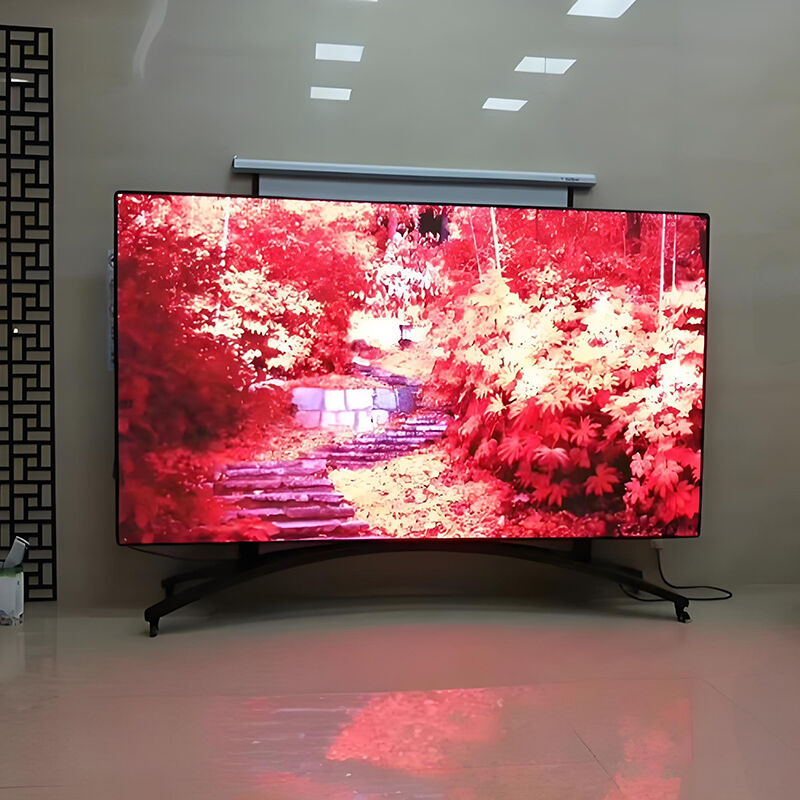
LED Display Manufacturing: From Substrate to Finished Panel
PCB Substrate Preparation and Circuit Integration
Manufacturing starts right at the heart of things with printed circuit boards (PCBs). First comes the substrate prep work where those copper clad laminates get etched with real precision to create all those conductive paths we need. Photolithography does most of the heavy lifting here, defining those tiny circuit patterns down to the micron level which matters a lot for keeping signals strong and managing heat in those packed LED modules. Next step is applying a solder mask over the copper traces so they don't oxidize, plus there's that silkscreen stuff that helps folks know exactly where components go when putting everything together. Then come the integrated circuits (ICs) and connectors mounted using surface mount tech (SMT). Reflow soldering creates solid electrical connections throughout. Industry stats tell us something pretty important too - around 38% of LED displays fail during their early life because of problems with the PCB itself according to the Electronics Manufacturing Report from 2023. That number really highlights why getting this base layer right is so crucial for any successful product.
SMD LED Mounting, Wire Bonding, and Protective Encapsulation
Surface-mount device (SMD) LEDs are placed on prepared PCBs using high-speed pick-and-place machines achieving 98.5% placement accuracy. Gold wire bonding then establishes reliable electrical connections between LED chips and circuit pads, with bond strength exceeding 8g-force to endure thermal cycling. Protection follows through a three-tiered encapsulation strategy:
- Adhesive on Board (AOB) seals components against moisture ingress
- Conformal coating provides chemical resistance for outdoor-rated displays
- Silicone encapsulation fills LED cavities to prevent mechanical pixel damage
This integrated protection enables IP65-rated displays to operate reliably across -30°C to 60°C while supporting lifespans exceeding 100,000 hours. Automated optical inspection (AOI) validates bonding quality with 99.2% defect detection accuracy.
Module Calibration, Cabinet Assembly, and Quality Assurance
Each LED module undergoes precision calibration using metrology-grade instruments to ensure visual consistency across the entire display system. Key parameters include color uniformity (∐E < 2.0), brightness uniformity (±5%), and gamma correction alignment.
| Calibration Parameter | Tolerance Threshold | Measurement Instrument |
|---|---|---|
| Chromaticity | ±0.003 CIE x,y | Spectroradiometer |
| Luminance | 500–1500 nits ±5% | Luminance meter |
| Viewing Angle | 140°–160° horizontal | Goniophotometer |
Calibrated modules are assembled into cabinets using aviation-grade aluminum frames engineered to withstand 50mph wind loads. Final quality assurance includes 72-hour burn-in testing, thermal cycling (-40°C to 85°C), and pixel-level defect scanning. Signal transmission is validated across all supported interfaces—including HDMI, SDI, and network protocols—before certification.
LED Display Functionality: Pixel Architecture and RGB Control
Individual Pixel Structure: RGB Subpixel Layout and Pixel Pitch Impact
An LED display pixel is basically made up of three tiny subpixels red, green, and blue (RGB) arranged in different geometric patterns like stripes, deltas, or matrices depending on the manufacturer's design choices. When these subpixels work together through additive color mixing, they can create more than 16 million different colors. If all three are turned on at maximum brightness, they produce what we see as pure white light. The term pixel pitch refers to how far apart the centers of neighboring pixels are from each other. This measurement has a direct impact on both the resolution density and how close someone needs to stand to view the display clearly. Take a 1.5mm pitch display for instance it packs around 440,000 pixels into just one square meter, which makes images look really sharp even when viewed up close according to a study published by Ponemon Institute last year. Displays with larger pitches above 4mm sacrifice some resolution but gain advantages in terms of lower costs and better brightness performance, making them popular for big venues where people tend to watch from farther away. To get the best results, manufacturers spend a lot of time adjusting the arrangement of subpixels and optimizing their fill factors. This helps boost contrast levels, reduce those annoying dark spots between pixels, and keep colors looking consistent throughout the entire screen area.
Signal Processing and Image Rendering in LED Display Systems
End-to-End Data Flow: Video Input to Driver IC Signal Conversion
When video comes into the system through media players or video processing units, these components adjust and prepare the signal so it fits what the display panel can handle natively. Control systems then get all those modules working together on the same timeline before sending the information along high speed cables to the driver integrated circuits. What happens next is pretty amazing actually these tiny chips convert digital commands into carefully timed electric pulses that correspond exactly to each little subpixel on screen. Most displays start around 60Hz refresh rate but some top end models can go as high as 3840Hz. This kind of setup makes moving images look smooth and clear, gets rid of annoying screen tearing issues, and allows for instant rendering responses that most people won't even notice lagging behind.
PWM Brightness Control, Refresh Rate Synchronization, and Flicker Mitigation
LED driver ICs manage brightness levels through something called Pulse Width Modulation or PWM for short. Basically, they switch the current on and off really fast which adjusts how bright things look without messing with the colors. The frequency here gets pretty high too around 3840Hz so there's no annoying flicker that shows up when filming with fast cameras or in places where lighting needs to be just right. All the modules work together in sync to keep images looking smooth and continuous. There are also smart algorithms built in that automatically adjust based on surrounding light conditions. What does all this mean? Well, systems consume about 23% less power overall and last longer since the LEDs and their supporting electronics don't get as hot over time.
FAQ
What causes early LED display failures?
According to industry statistics, around 38% of early LED display failures are due to issues with the PCB layer.
How are LED displays protected from environmental factors?
Protection involves adhesive on board, conformal coating for chemical resistance, and silicone encapsulation to prevent mechanical damage, allowing IP65-rated displays to handle extreme conditions.
What is pixel pitch and why does it matter?
Pixel pitch refers to the distance between the centers of adjacent pixels, influencing resolution density and optimal viewing distance.
How do LED displays render smooth images?
They use driver ICs, high refresh rates, and PWM brightness control to render smooth images without flicker or tearing issues.